Pop. Sci book or Textbook?
I recently read a “popular science” book on a topic that I felt I needed to learn more about. The book was well-written, ideas were clearly explained, and I finished… Read more Pop. Sci book or Textbook? →
I recently read a “popular science” book on a topic that I felt I needed to learn more about. The book was well-written, ideas were clearly explained, and I finished… Read more Pop. Sci book or Textbook? →
One of the most important (and perhaps most counter-intuitive) ideas students need to grasp when learning about projectile motion is that the horizontal and vertical motion of a projectile are independent of each other. There are some lovely ways to demonstrate this, including the classic monkey and hunter demo, but here’s a quick and easy way to convince students of this if you don’t happen to have a brilliant technician:
I’m teaching the AS content for the AQA Physics A-level for the second time this year, and have recently had my students carry out the core practical to “find a value for g using a free fall method”. I used the same approach as I used last year, using a “g-ball” as shown in the video below, but have simplified the worksheet that I used. (The one I used last year asked the students to carry out parts of the uncertainty analysis as they were going along, whereas this one… Read more Finding acceleration due to gravity: take 2 →
I’ve found the videos below useful for showing my students how to read a vernier scale: Click here for a worksheet to practise reading these scales. Click here for online practice questions
It’s important that A-level Physics students can handle numbers in standard form and use prefixes with units. Below are some resources students can use to help them revise these skills: Video on how to convert numbers into / from standard form: Click here for online questions to practise converting to and from standard form. Video on how to use prefixes with units: Click here for practise questions using prefixes.
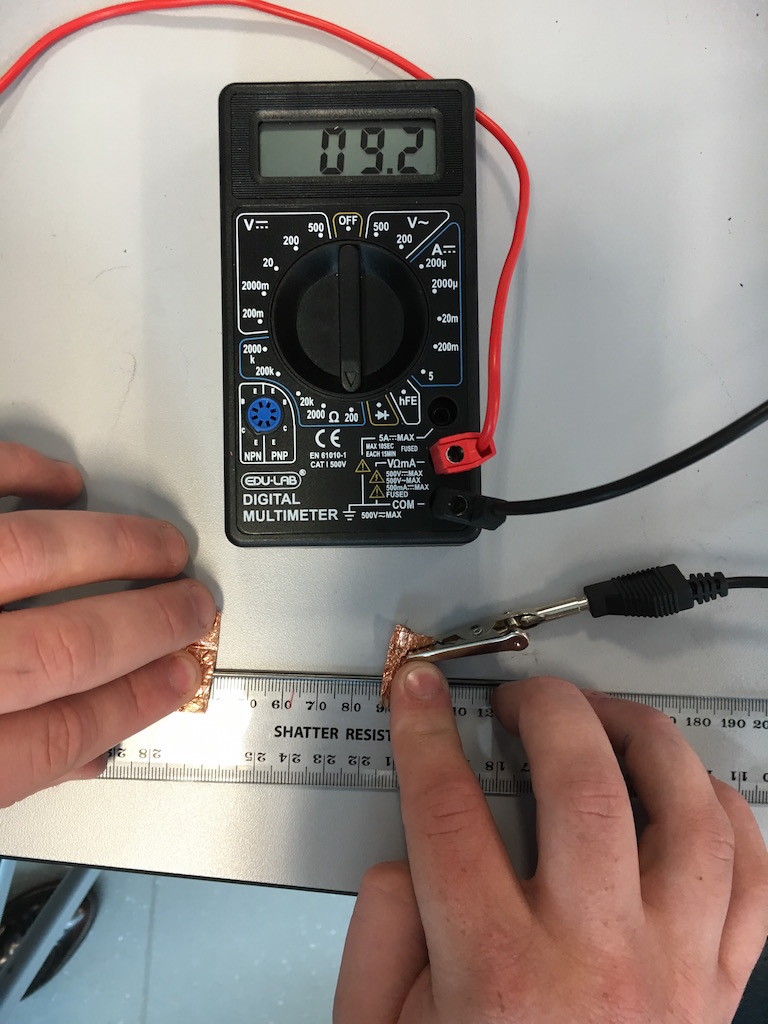
I’ve just started teaching my second lot of year 12 students the new (AQA) Physics A-level. I believe the move from coursework / assessed practicals in the form of EMPAs etc. is… Read more Introductory A-level Physics Practical? →
There have been a spate of articles recently about the “crisis” in teacher recruitment. Such pieces cite a number of factors which might be responsible, but one that stood out to me was the suggestion that there is a “trend for middle-aged teachers to become private tutors” which is “stripping the profession of experienced people”. I’m not sure whether this is true – I’ve not seen any data on it, but the TES recently provided an example of this phenomenon in an article by a “successful history teacher” explaining why he was leaving the… Read more Why teach when you can tutor? →
Circular motion can be a tough topic to teach because some aspects of it are counterintuitive. This is a really simple and elegant way to get across some of the key ideas needed to grasp the physics of what’s going on when an object moves in uniform circular motion. The film was shot and edited by Ed Prosser. The Ogden Trust kindly helped with equipment costs and David Sang advised on the script. One you’ve demonstrated that the velocity of an object in uniform circular motion is at a tangent… Read more Simple Circular Motion Demonstrations →
I know I will cry when I eventually leave the school where I’ve worked for the last decade or so. I won’t be able to help it – I’ve cried on my final day at every school I’ve ever belonged, as a student or teacher. The last time was when I left my second teaching job, in the belief that I was leaving the profession for good. I had been studying part-time for a masters in Science Communication and this had led to an offer of a job as a… Read more Why I returned to teaching →