The Young Atheist’s Handbook
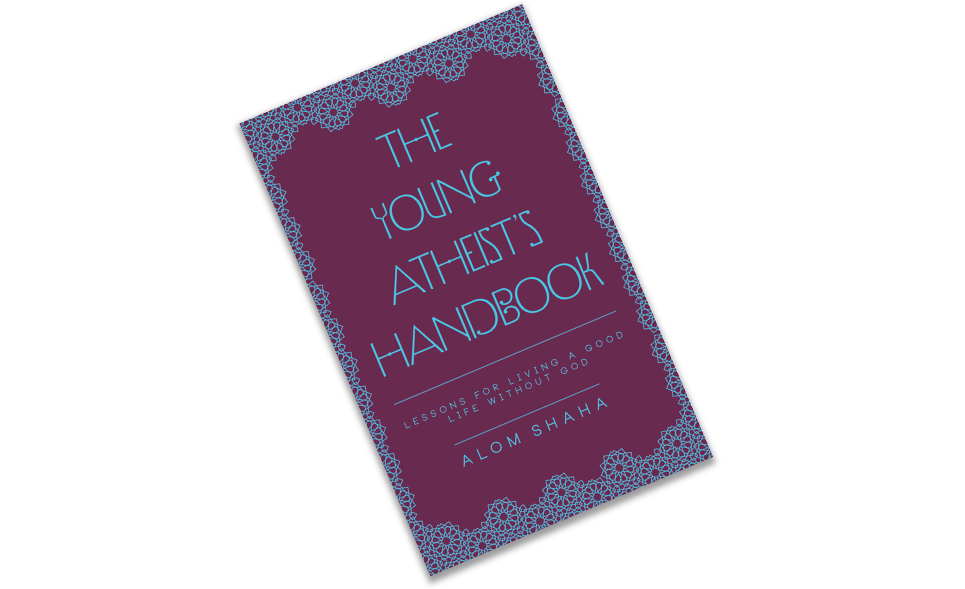
This is a book for anyone who thinks about what they should believe and how they should live. It’s for those who may need the facts and the ideas, as well as the courage, to break free from inherited beliefs. In this powerful narrative, Alom Shaha shows that it is possible to live a compassionate, fulfilling, and meaningful life without God.
‘A very special book.‘ — Stephen Fry
‘More than just a great handbook, this is an honest and often very moving story about valuing truth over hope, even in the face of grief.’
– Tim Minchin, comedian
‘A touching personal account that makes for a courageous and compelling read. This is among the most powerful and convincing arguments against religion that I have come across, and it is written in a way that is never patronising or trivialising.’
– Professor Jim Al-Khalili OBE, physicist and broadcaster
‘If the style is a guide to the man, he is gentle and persuasive – the type of teacher you would have loved to have had educate you.’
– Nick Cohen, in The Observer
‘A book that destroys the cliche of the atheist as joyless rationalist and shows the humanity, love, and concern that often lies behind godless thinking.’
– Robin Ince, writer and comedian
‘Like an intelligent, frank conversation with a vibrant teacher … Shaha’s talent for raw, lucid narrative makes this an uncommonly moving contribution to debate.’
– Sydney Morning Herald
‘Like many bright and curious children before and since, kind teachers, books and school provided the young Alom Shaha with a ladder out of inner city poverty and an escape from his abusive, feckless father. But The Young Atheist’s Handbook is no anti-Muslim misery memoir. Rather its strength is the way he explores his life and faith scientifically, through a series of thought experiments. From its taboo busting opening, when, in a simple experiment he eats pork for the first time, Alom Shaha’s rational exploration of the corrosive power of religious indoctrination is refreshingly down to earth, heartfelt and deeply moving. It combines a raw personal story of his Bangladeshi Muslim background with the understated and carefully researched honesty of a scientist seeking the truth, and of a teacher wanting to free young minds. An inspiring and brave book that speaks for thousands who dare not admit their atheism.’
– Samira Ahmed, Journalist and broadcaster (BBC Radio 4, ex-Channel 4 News)
‘Alom Shaha’s The Young Atheist’s Handbook is moving, heartwarming, and thoughtful … Many today are despairing, grappling with doubt, or fearful for their lives for wanting to leave Islam and religion. Apostasy is still punishable by death in a number of countries worldwide. Alom’s honest journey of why and how he has freed himself from religion’s hold will be essential reading for many of them, and it will surely empower and inspire.’
– Maryam Namazie, human rights activist
‘Insightful, conversational, intelligent, enlightening, intimate, and just plain eye-opening. Shaha opens his life, his heart, and his mind to us in a compelling journey towards unbelief.’
– Dr Leslie Cannold, author of The Book of Rachael
‘Frisbee your skullcap, grill up a bacon sandwich, and enjoy The Young Atheist’s Handbook.’
– John Safran, documentary-maker and broadcaster
‘Alom Shaha has shrugged off the shackles of poverty, racism, and, most of all, religious superstition, to begin to fulfil his potential as a human being. In this wise, compassionate, honest, and often heartbreaking book, he tells of his remarkable journey from a tough inner-city council estate to the rejection of the Islamic beliefs of his Bangladeshi immigrant community. It took a lot of guts to “come out” as a nonbeliever, but Shaha did it to show others who harbour severe doubts about their faith that they are not alone. This is an important and courageous book that needed to be written.’
– Marcus Chown, author and broadcaster
‘Alom’s circumstances will be shared by many young people from Muslim backgrounds growing up today. His personal account of his own experiences will be an indispensable source of comfort for them, and a movingly written insight for any reader.’
– Andrew Copson, director of the British Humanist Association
‘This is all very annoying. While most of us struggle to put two coherent sentences together, Alom Shaha seems to have knocked out this beautifully written and important book at the same time as teaching physics, and making films. Atheists and religious people alike should read this to see that the path to enlightenment is not always easy, especially if you come from a culture in which being faithless is derided. But more importantly, young people who are working out their own path should read it to see that you can be free to think for yourself’.
– Adam Rutherford, science broadcaster
‘This is a celebration of a life well lived with heart and mind at work…Those who want clear arguments about the impossibility of belief, as well as those who enjoy a well told and illuminating memoir, will be pleased with this book’
– Folly Gleeson, writing in the Newtown Review of Book
4.4 out of 5 stars from over 50 reviews on Amazon
4.14 out of 5 stars from over 40 reviews on Goodreads
About the book
The Young Atheist’s Handbook is a book for anyone who thinks about what they should believe, and how they should live their life. It may outrage some, disgust others, but I hope it will inspire and help many more to make up their own minds.
I grew up in a strict Bangladeshi Muslim community in South-East London in the 1970s and 80s. I was expected to go to mosque regularly and recite passages in Arabic from the Quran, without being told what they meant. I spent my teenage years juggling two utterly different worlds: my chaotic, sometimes funny, sometimes tragic family life on a council estate, and that of a student at a privileged private school set amongst the idyllic green playing fields of Dulwich.
In the years since I realized I neither had nor wanted faith in the religious sense, I’ve spent a lot of time trying to understand the world and how to develop my own moral and ethical compass. The Young Atheist’s Handbook is the result of that thinking.
The roots of my beliefs are based not in the religion of my birth but in the science I learned at school and the books I devoured at home. I was lucky to find a way to think for myself about how the world works, about God and faith and doubt, and how to live my life in the best possible way without necessarily being tied down to what my parents, priests or teachers might have told me to believe.
The book is made up of a series of “lessons”, which explore religion in the context of knowledge from science and philosophy, as well as ideas from the greatest minds in history. Along the way, I’ll tell the story of how I came to question the beliefs that were handed down to me by my parents, how I encountered the ideas that I now hold dear and how I came to define myself as an atheist. Combining factual content with a personal narrative, I’ve created a handbook for others who, like me, may need the facts and the ideas – and the courage – to break free from the beliefs they have simply inherited, and to decide for themselves what they believe and who they want to be.
The Young Atheist’s Handbook is published in Australia by the lovely people at Scribe Publications and in the UK by Biteback Publishing. It is also available in a Turkish language edition. Rights for the US and Canada and other international territories are still available. For any further information, drop me a line or contact my agent Catherine Clarke at the Felicity Bryan Literary Agency.